Case studies
Dr Evona Teh CEng FIET APMP
Published: 30/10/2025
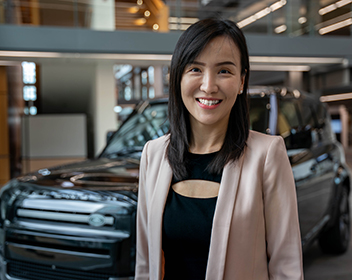
Education and qualifications:
Certified Project Manager, Association for Project Management (APM)
PhD in Intelligent Transportation - Human Machine Interaction (Funded by the UK Engineering Research Council and Jaguar Land Rover), University of Leeds
MEng in Electrical and Electronic Engineering, Imperial College London
Job title:
Strategic Foresight Innovation Lead (Corporate Strategy)
Employer:
Jaguar Land Rover
What/who inspired you to become an engineer?
I was inspired by the women who raised me – inventive, resilient problem-solvers who taught me to build rather than wait. That mindset drew me to engineering over medicine: I wanted to design solutions and shape the future, not just treat its consequences, turning curiosity into long-term impact.
Please describe your role within the workplace.
I began in engineering, delivering advanced vehicle technologies and bespoke innovation programmes, before transitioning into strategy. I later co-founded the Strategic Foresight function in Corporate Strategy, where I now advise senior leadership and support board-level decision-making on Horizon 3 opportunities in sustainability, intelligent systems and future mobility.
What is the most challenging aspect of your role?
Foresight means working in uncertainty. The challenge is turning weak signals into meaningful direction, balancing long-term opportunity against today’s pressures. I build confidence and alignment across diverse stakeholders and ensure that future-facing thinking remains grounded in technical reality and societal relevance.
What is the most enjoyable aspect of your role?
I enjoy shaping long-term vision and helping the business interpret complex technological and societal shifts. Because I built products earlier in my career, I understand how strategy translates into delivery, which helps me bridge future vision with engineering practice. Turning foresight into something tangible is deeply rewarding.
What is the biggest career highlight or achievement you’re most proud of?
Being appointed Visiting Professor at Imperial College London by the Royal Academy of Engineering is a defining honour. I am also proud to be named one of the UK’s Top 50 Women in Engineering and a WISE Awards finalist, with recognition from HRH Princess Anne. Co-founding Strategic Foresight at Jaguar Land Rover (JLR) was also pivotal.
Why did you choose to become professionally registered?
Becoming a Chartered Engineer (CEng) was a way to validate my expertise and uphold professional standards. It signalled a commitment to ethical leadership and lifelong learning and gave me the platform to advocate confidently for inclusion and responsible engineering.
I would recommend professional registration because…
…it is a globally respected benchmark of competence, integrity and trust. It opens doors to leadership, governance and influence in the profession. For women and under-represented engineers, registration is also a powerful statement of identity and credibility. It shows we belong and lead at the highest standard.
What career advice would you give to your younger self?
I would tell my younger self that strength grows from within. Like an egg, life begins when it breaks from the inside. Don’t wait for permission. Speak up even when your voice shakes, and remember that being different is your superpower. Your presence creates possibilities for others.
Do you participate in mentoring, volunteering, or membership of other engineering groups?
Yes. I am a Professional Review Interviewer with the Institution of Engineering and Technology, sit on Imperial College’s Industrial Advisory Board, and mentor engineers in the UK and internationally. I am also a public-facing spokesperson for JLR, including the Defender Women’s Rugby World Cup campaign, and champion diversity through BBC Radio, Financial Times, and the Department of Business and Trade Chartered Week.
If relevant, please list three favourite projects you have worked on:
Developing the dual-screen infotainment system for the Range Rover Velar was a milestone in user-centred design. Co-founding JLR’s Strategic Foresight function reshaped how the company plans for future mobility. Most recently, my work in Kenya on renewable energy for rural healthcare has been deeply meaningful in scaling engineering for social good.
Do you identify as disabled, or as a member of a minority or under-represented group? Would you like to comment on what impact or influence you feel this has had upon your career?
As a Southeast Asian woman in engineering, I’ve often navigated cultural expectations and underrepresentation. Inspired by strong women problem-solvers in my family, I learned to challenge stereotypes early. These experiences built my resilience and fuelled my commitment to inclusion, creating space for others and widening representation in engineering.