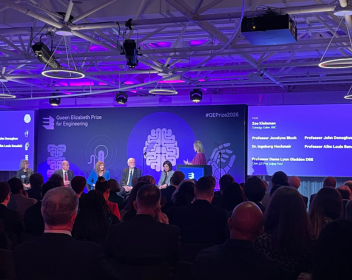





Nine engineers have been awarded the prestigious Queen Elizabeth Prize for Engineering (QEPrize) for their pioneering work on modern neural interface technologies.
Graeme Clark, Erwin Hochmair, Ingeborg Hochmair, Blake Wilson, John Donoghue, Alim Louis Benabid, Pierre Pollak, Jocelyne Bloch and Grégoire Courtine were formally announced as the winners by Lord Vallance, Chair of the Queen Elizabeth Prize for Engineering Foundation. The official ceremony was hosted by BBC Technology Editor Zoe Kleinman at the Science Museum in London on 3 February.
Now in its thirteenth year, the award celebrates engineering visionaries whose innovations have made a profound impact on society. The prize has previously been awarded to the inventors of the internet, the GPS (Global Positioning System) and for modern machine learning (artificial intelligence).
This year’s laureates have driven advances in technologies that link engineered systems with the nervous system, restoring functions such as hearing, movement, and communication for people affected by sensory loss, paralysis, and neurological disease. These advances mark a new frontier in neuroprosthetics and have transformed complex neuroscience into practical technologies that restore independence and improve quality of life. These transformative technologies include cochlear implants and brain-computer interfaces.
The engineers will share a £500,000 prize, and will be officially honoured at a QEPrize Presentation Ceremony at a later date, where they will receive a trophy designed by 2026 ‘Create the Trophy’ winner Kayla Taqiya, age 21, from Indonesia.
The Engineering Council would like to extend its congratulations to all the winners.
For more details on this year’s winners and the full announcement, please visit the Queen Elizabeth Prize for Engineering website.